
Bringing Cotton Candy Grapes to Canada
Kaitlin McLauchlin
November 27, 2018
This paper is apart of AGR1110, Introduction to AgriFood
Systems at the University of Guelph, Canada. For further details, contact Prof. Manish N. Raizada (raizada@uoguelph.ca)
Product Description
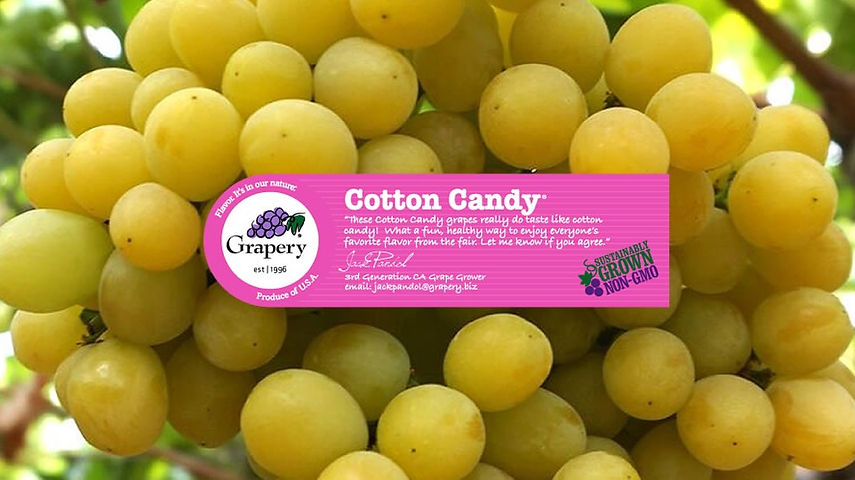
Cotton candy grapes are an innovative green grape variety that tastes exactly like cotton candy. The grapes are currently exclusively grown in California by the company who initial bred the variety, The Grapery (Grapery, 2017). The grapes were developed naturally through the process of cross-breeding two wild grape varieties, one being a type of concord and the other a variety of Vitis vinifera (Geggel, 2017) . Due to this, the grapes are not genetically modified, non-GMO, and obtain their flavour naturally with no additional additives (Grapery, 2017). The grapes have a short growing season, and are only available to be harvested in California from mid August to late September (Grapery, 2017). Due to the grapes natural sweet flavour, the cotton candy variety naturally has about 12 percent more sugar than traditional consumer grapes giving them their distinct sugary taste (Geggel, 2017).
The creation of this variety took over six years to perfect and officially came into production in 2011 when The Grapery dedicated two acres for the variety (Geggel, 2017). In 2017 the production area was increased to 100 acres total from the same producer (Geggel, 2017). Currently, the product is imported into Canada and is sold at a small amount of higher-scale retail locations (Twomey, 2016)
Licensing Constraints
Cotton candy grapes are currently patent protected through the breeding partner of The Grapery, International Fruit Genetics, IFG (Grapery, 2017). Due to their licensing restrictions, the grapes are only available to be grown by The Grapery in Shafter, California. IFG is in control of the sales and licensing of the variety’s plant cuttings and have expressed that the grapes are currently unavailable for sale or licensing (Grapery, 2017). Both the name, Cotton Candy Grapes, and the plant cuttings themselves are patented through IFG and The Grapery (Grapery, 2017) further preventing wide adaptation of the variety to the consumer market. Despite the resistance to expand the producers of the grapes, IFG recently partnered with a grower in Mexico this past June in order to extend the availability of the variety (Ramsey, 2018). The grapes grown by the new grower in Mexico will be harvested from May to June, extending the yearly availability of the grapes from roughly one month to three months (Ramsey, 2018). Both breeding partners can be contacted as follows:
The Grapery
501 N Driver Road
Shafter, CA
93263
661-326-8004
IFG
441 Vineland Road
Bakersfield, California
USA 93307
661-363-8463

Market Opportunity
The target market for cotton candy grapes is the middle to upperclass Canadians as they have a larger budget to spend on premium products. The grapes will be particularly marketed towards those who are looking for a new healthy and sweet treat that tastes like candy. The grapes may also be marketed towards children as a healthy alternative to candy. This will be attractive to parents who wants new or better options to give to their kids instead of unhealthy snacks.

Target Producers
The target area for producers of the grapes is the Niagara region of Ontario. This region already has a successful and established grape and wine market and production system (BB Niagara, 2017). The area is also currently home to the annual grape and wine festival, giving opportunity to promote the new variety at the event (Wine Country Ontario, 2011). Ontario is the ideal location for this product as it is the leading grape producer for Canada, producing about 70% of all Canadian grapes (Grape Growers of Ontario, 2010). As shown in the figure above taken from (Grape Growers of Ontario, 2010), the Niagara region is the largest grape producer in Ontario:

Cost Analysis
Cotton candy grapes have a lower production cost than traditional green grapes as they require less thinning of the crop (Twomey, 2016). This provides incentive to Canadian growers as they can produce the crop for less and then sell the crop for more than double the price of traditional varieties.
Growers have an average yield of 3.6 tonnes per acre (Deloitte, 2016), meaning that on average 7936 pounds of grapes can be produced per acre. Since cotton candy grapes sell on average for about $6.00 per pound, an acre of the variety would provide about $47,616 in sales.
Looking at the table from (Molenhuis, 2015), the production costs of concord grapes, an appropriate comparison non-premium variety, are outlined:
It can be assumed that with less of a need for thinning of the crop that the pruning cost would be lessened. If estimated to be around half the cost of traditional grapes, the cost of pruning per acre for a 4 tonne yield/acre would be reduced to about $145, reducing the overall variable fixed cost to about $2497. With gross income then increasing to an estimated doubled income per tonne, the approximate gross income for cotton candy grapes would be about $974 per tonne. With the new gross income and fixed costs, the contribution margin for the variety would be about $1399, a significant improvement from the concord grape model.
Marketing Strategy
The marketing strategy for cotton candy grapes would be to sell the variety as a niche premium grape product. Selling at around $6.00 CAD per pound at the consumer level, the grapes are more than double the price of regular green grapes (Greggy, 2017). Due to their high price, the strategy of marketing the grapes as a premium product justifies the higher price tag.
Competitors
As The Grapery is the only grower able to grow cotton candy grapes currently, if brought to Canada they would be the sole competitor for locally grown cotton candy grapes. As there has been an increase in awareness and the promotion of locally grown food in Canada a Canadian grown grape would have a higher attractiveness to Canadian consumers as opposed to their American counterparts (Strailey, 2013).
Apart from other growers of cotton candy grapes, there are currently no premium grape varieties grown and sold in Canada (Conforti, 2011). Due to this, there are is virtually no premium grape market at the Canadian level. Although there are other premium grape varieties imported from the United States, there are no locally grown options (Conforti, 2011).
Current Retailers
Currently, cotton candy grapes are sold at select Canadian retailers, specifically higher-scale or specialty grocery stores (Grapery, 2017). Some of these retailers include:
Farm Boy
1427 Ogilvie Road
2nd Floor
Ottawa, ON
K1J 8M7
613- 247-1007
Costco
415 West Hunt Club Road
Ottawa, ON
K2E 1C5
1-425-313-8100
Whole Foods
250 Forest Street
Marlborough, MA 01752
617.492.5500

Benefits to Canada
There are many benefits which could be brought to Canada through the adaptation of cotton candy grapes. One of the main benefits would be in improvement and opportunity to grow the grape and wine sector. With the potential for a new grape variety being available to wineries, there is the opportunity for existing wineries to develop new wines (Grape Growers of Ontario, 2010). There is also the potential for the variety to be used in ice wine production, as the already sweet wine type may be enhanced by the increased sugar content of cotton candy grapes (Cofadmin, 2015). The inclusion of cotton candy grapes into the Canadian wine sector is ideal as about 97% of grapes grown in Ontario are used for wine (Grape Growers of Ontario, 2010). Other benefits may include the production of novelty products such as jellies or raisins which could be marketed specifically as cotton candy grape varieties.
Future Recommendations
If brought to Canadian producers, the future aim of the variety wold be to expand production of the grapes in order to reduce the overall cost to consumers. Through increase in crop size, the overall cost per pound to producers would lower. With this lower production cost per product pound, the producer would still be able to make their margins while also lower the overall costs to consumers. With a decrease in the costs to consumers, those who would have been unable to consume the premium variety due to its cost would have a greater opportunity to purchase the crop. This in return would increase the overall market size, thus increasing demand and in return providing incentive to growers to increase the production size of the crop.
Summary
Overall, the integration of cotton candy grapes to the Canadian agriculture sector has the potential to provide a new variety for consumers, growers, and product manufacturers to explore. If Canadian growers are able to obtain the licensing to grow the variety then there are many benefits which could be brought to the grape and wine sectors, specifically those in the Niagara region. With there being virtually no competitors to this variety in Canada, the opportunity to establish a premium grape sector in Canada should be implemented. Having been already proven to be popular in Canada, the adaptation of the cotton candy grape variety to Canadian growers could grow the market and increase profitability for Canadian retailers and producers. This variety of grapes holds a wide range of opportunity for Canada.
References
BB Niagara. (2017, August 01). Why Ontario is Perfect for Growing Wine | Niagara Wine Growing. Retrieved November 27, 2018, from https://bandbniagara.com/wine- growing-ontario/
Cofadmin. (2015, August 27). Niagara Ice Wine. Retrieved November 27, 2018, from https://www.tourniagarafalls.com/blog/niagara-ice-wine
Conforti, P. (2011). Looking ahead in world food and agriculture: Perspectives to 2050. Rome: Food and Agriculture Organization of the United Nations.
Deloitte. (2016). Ontario Wine and Grape Industry Performance Study (Rep.).
Gaeta, D. (2016). Economics, governance, and politics in the wine market: European union developments. S.l.: Palgrave Macmillan.
Geggel, L. (2017, July 17). Cotton Candy Grapes: The Science Behind the Sweet, Carnival Taste. Retrieved November 27, 2018, from https://www.livescience.com/ 59831-cotton-candy-grapes.html
Grape Growers of Ontario. (2010). Ontario's Grape and Wine Industry. Retrieved November 27, 2018, from http://www.grapegrowersofontario.com/industry_facts
Grape Growers of Ontario. (2010). Grape Facts. Retrieved November 27, 2018, from https://www.grapegrowersofontario.com/grape_facts
Canada, Grape Growers of Ontario. (2014). Grape Growers of Ontario Annual Report (Vol. 66). St Catherines, ON.
Grapery. (2017). Unique Cotton Candy Grapes: A Circus Of Sweetness. Retrieved November 27, 2018, from https://grapery.biz/index.php/our-grapes/cotton-candy
Grapery. (2017). Frequently Asked Questions. Retrieved November 27, 2018, from https://grapery.biz/index.php/faq
Lindell, C. (2011). Cotton candy flavoured what now? Candy Industry, 176(10), 1. Retrieved from http://sfx.scholarsportal.info.subzero.lib.uoguelph.ca/guelph/ docview/903198109?accountid=11233
Molenhuis, J., & Slingerland, K. (2006). Establishment and production costs for grapes in Ontario: 2005 economic report. Ontario: Ministry of Agriculture and Food.
Molenhuis, J., & Slingerland, K. (2010). Establishment and production costs for grapes in Ontario: 2009 economic report. Ontario: Ministry of Agriculture and Food.
Molenhuis, J. (2015). Establishment and production costs for grapes in Ontario: 2014 economic report. Ontario: Ministry of Agriculture and Food.
OMAFRA. (2009). Ontario's Grape Integrated Pest Management. Retrieved November 27, 2018, from http://www.omafra.gov.on.ca/IPM/english/grapes/index.html
Penny, J. (2012). Adapting to Climate Change: Challenges for Niagara. Retrieved November 27, 2018.
Ramsey, S. (2018, June 23). Cotton Candy Grapes: Everything to Know About the Unique Hybrid. Retrieved November 27, 2018, from https:// www.wideopeneats.com/cotton-candy-grapes/
Strailey, J. (2013, January 1). Better Bites. Progressive Grocer. Retrieved from http:// link.galegroup.com.subzero.lib.uoguelph.ca/apps/doc/A314399479/AONE? u=guel77241&sid=AONE&xid=8afa432a
Twomey, S. (2016, November 16). Berry boom takes off in US. The Weekly Times. Retrieved from http://sfx.scholarsportal.info.subzero.lib.uoguelph.ca/guelph/ docview/1839145658?accountid=11233
Walker, G. (n.d.). Crop profile for grape in Canada, 2016 (Canada). Agriculture and Agri- Food Canada.
Webber, L. (2013). Retailers reassure customers on cotton candy grapes. Supermarket News, Retrieved from http://sfx.scholarsportal.info.subzero.lib.uoguelph.ca/ guelph/docview/1425578043?accountid=11233
Wine Country Ontario [Pamphlet]. (2011). The Wine Council of Ontario.